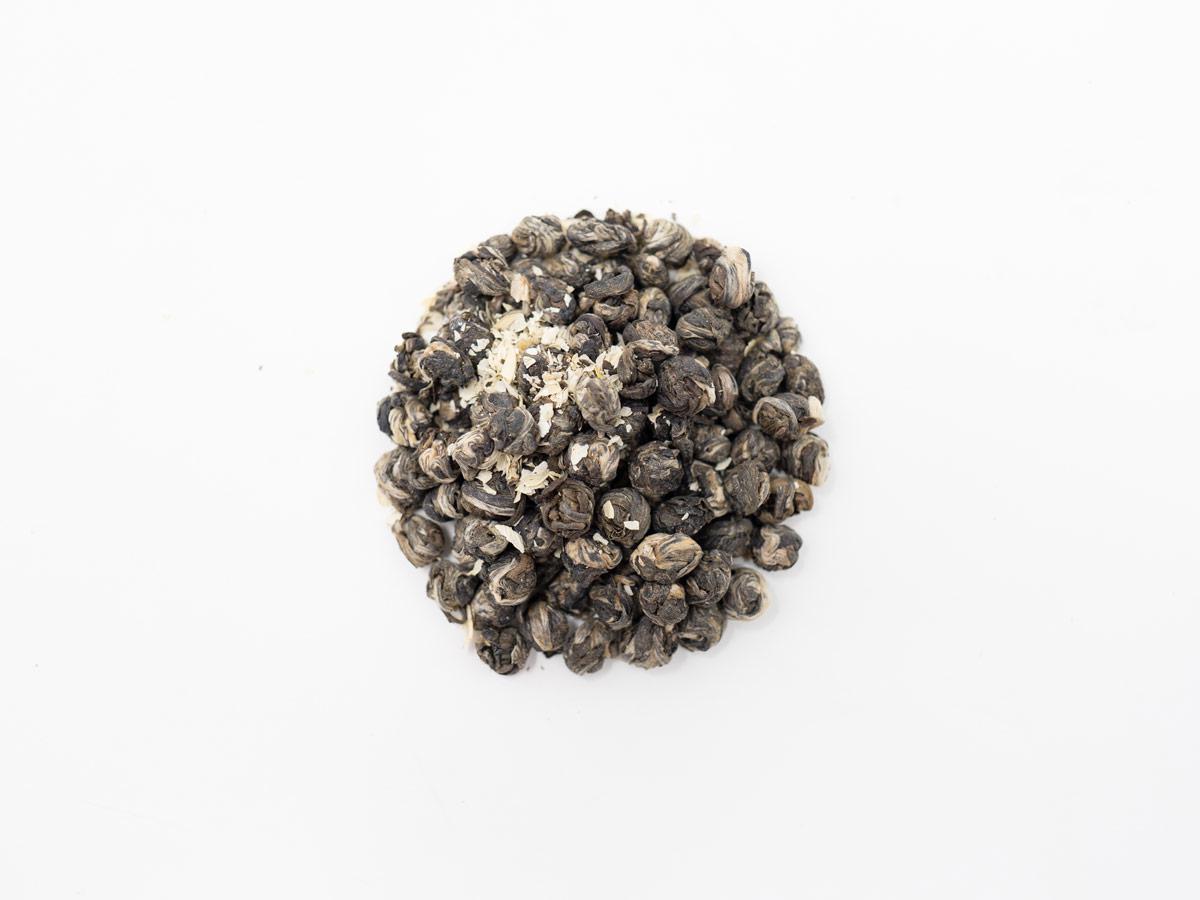
Imagine a cup of tea where delicate white blossoms drift across a pool of jade-green tea, almost like snow falling on water. 
Bi Tan Piao Xue (translated “Snow Flakes Falling Upon a Jade Pond”) does just that, as one of China’s most visually stunning and aromatic jasmine teas. 
As you sip this tea, the experience begins with white petals floating across the top and leaves unfurling below, creating the image that inspired its name. 

Origin and History

One of the most unique things about this tea is that it’s relatively new. 
Developed in the 1990s by tea master Xu Jinhua, the goal was to find a way to elevate traditional jasmine tea by focusing not only on fragrance, but also on the quality of the underlying green tea and the tea’s visual elegance. 
Created in Sichuan Province, where tea is deeply tied to leisure and long conversations, Bi Tan Piao Xue’s reflection of that culture helped to drive its popularity. 

Processing

 
Bi Tan Piao Xue is also unique in its meticulous, labor-intensive production process. The base of the tea is a high-quality green tea harvested in early spring. Typically gathered from high-altitude regions like Mount Emei or Mengding Mountain, the young leaves provide a delicately sweet foundation. 
Then it’s time to pick the jasmine blossoms. 
Jasmine flowers are picked in the afternoon on sunny days, just before they bloom—when they are at their most aromatic stage (often called the “tiger’s palm”) to ensure maximum fragrance.
Next comes the scenting process–where dried tea leaves are layered with fresh, aromatic flowers, allowing the leaves to absorb natural floral scents. For Bi Tan Piao Xue, this process is repeated 5–7 times over three weeks, with fresh flowers layered in each round.
Finally, some dried jasmine petals are intentionally left in the final product to enhance both the visual appeal of the tea and the aromatic experience.

Health Benefits

The natural aroma of jasmine in this tea is known for its calming effect, while the green tea base provides a light lift of caffeine—just enough to refresh without overwhelming.
The green tea base also provides natural antioxidants that support overall health and wellness.

Flavor Profile

Bi Tan Piao Xue is beloved for its balanced taste. The freshness of floral aromas mingle with the mellow, slightly sweet liquor for a cup that is refreshing and beautiful. 
For the best results, use water at 176 degrees and steep for 2-3 minutes. As it brews, the white jasmine blossoms float atop the surface while the green tea leaves unfurl below. This striking contrast creates the signature “snow on jade pond” effect.
Though relatively new, Bi Tan Piao Xue captures something timeless: the balance between tea and flower, flavor and fragrance, function and beauty.
If you’re looking for a tea that invites you to engage all your senses, this is a can’t miss tea experience. 
Cameron Dodd
Written by

Cameron Dodd

Cameron was born in Tucson, Arizona, but has been a Phoenix native since she was 12. She joined the Sagebrush team in February of 2025 as our Coffee Education Specialist where she gets to inform customers and co-workers alike of the wonders of specialty coffee! When she’s not working, you can find her reading, writing, being involved at her church, trying new restaurants/coffee shops, and going on trips with her kids.

keep reading tea articles

View all

Bi Tan Piao Xue | A Tea That Blooms Before Your Eyes

Bi Tan Piao Xue | A Tea That Blooms Before Your Eyes

Imagine a cup of tea where delicate white blossoms drift across a pool of jade-green tea, almost like snow falling on water.  Bi Tan Piao Xue (translated “Snow Flakes Falling Upon a Jade Pond”) does just that, as one of...

Read more

The Soul of Oolong | The Legend, Craft, and Flavor of Ti Kuan Yin Tea

The Soul of Oolong | The Legend, Craft, and Flavor of Ti Kuan Yin Tea

Not every tea has an intriguing nickname like Iron Goddess of Mercy.  But Ti Kuan Yin tea isn’t like every other tea. Perhaps the most well-known of all the oolong teas, Ti Kuan Yin offers more than a delicious brewed...

Read more

blog graphic for Hackberry education: reads "english - irish - breakfast a breakdown of the breakfast teas""

English, Irish, and Scottish Breakfast Tea

Drinking hot tea has been a longstanding tradition in Europe, specifically in the United Kingdom. English, Irish, and Scottish breakfast teas have been a staple for many households for their bold flavors and tannin levels. Breakfast teas were produced to...

Read more

brown graphic with title chai tea: it's origin and evolution in dark brown text

Chai Tea 101 | Origin & Evolution

Chai is one of the most popular tea drinks globally. But did you know it’s not actually a tea type like black or green tea? Instead, it’s a spiced blend—often with black tea as its base—mixed with aromatic ingredients like...

Read more

Chamomile | The Simple Base to Many of Your Favorite Teas

Chamomile | The Simple Base to Many of Your Favorite Teas

In our conversation about the ingredients present in many of our teas, let's talk about chamomile. When we think of chamomile, words like rest, calm, healing, and a good night's sleep come to mind. These are all positive things! Therefore,...

Read more

Why Is Golden Monkey So Pricey?

Why Is Golden Monkey So Pricey?

Golden Monkey is widely considered one of the finest teas you can access in the US. Its near-sweet taste and smooth finish make for a delicious light cup of black tea fit to perk you up during a drowsy early...

Read more

learn the fundamentals of tea

View all

Black Tea 101 | History, Processing, and Health Benefits

Black Tea 101 | History, Processing, and Health Benefits

Hot. Iced. Sweetened. Unsweetened. You may think you know it. You may have been drinking it your whole life. 

But there are intricacies about black tea that are fairly unknown and truly staggering. It has started wars, been used as currency, and is the most popular type of tea in the world. But there’s more to this tea than banknotes and bloodshed and bottom lines. There’s history and processing and health benefits and more! 

Read more

Tea 101 | A Brief Overview of the Tea Plant

Tea 101 | A Brief Overview of the Tea Plant

It’s started wars, been used as currency, and–aside from water–it is the number one most consumed beverage in the world. What is it?  Tea, of course!  Tea may seem simple at first. It is, after all, just steeping leaves in...

Read more

China | Tea's Birthplace and Top Producer

China | Tea's Birthplace and Top Producer

Of all the tea origin stories, the history and evolution of tea in China is the most influential. Tea cultivation and consumption began here, making tea a deeply embedded part of Chinese culture since before the third century. Originally, monks...

Read more

Egypt | Historical and Cultural Impact of Tea

Egypt | Historical and Cultural Impact of Tea

  The art of drinking tea has significantly influenced many different regions and cultures for centuries. We have learned about the first discovery of tea in China and its migration through Europe and India. Now, this beloved beverage is consumed...

Read more

Fruit Tea 101: History & Benefits

Fruit Tea 101: History & Benefits

Fruit tea, served hot or cold, is naturally sweet and deliciously refreshing. But what exactly are we drinking when we drink fruit tea? Well, for starters, it may surprise you to hear that fruit tea is not technically ‘tea’. Tea...

Read more

India | A Top Producer of Our Favorite Teas
India | A Top Producer of Our Favorite Teas
The History of Tea in India: How They Became a Top Producer of Our Favorite Teas India and China are the two countries that contend for the title of “World’s Largest Tea Producer,” but their competition is a relatively recent...
Read more